
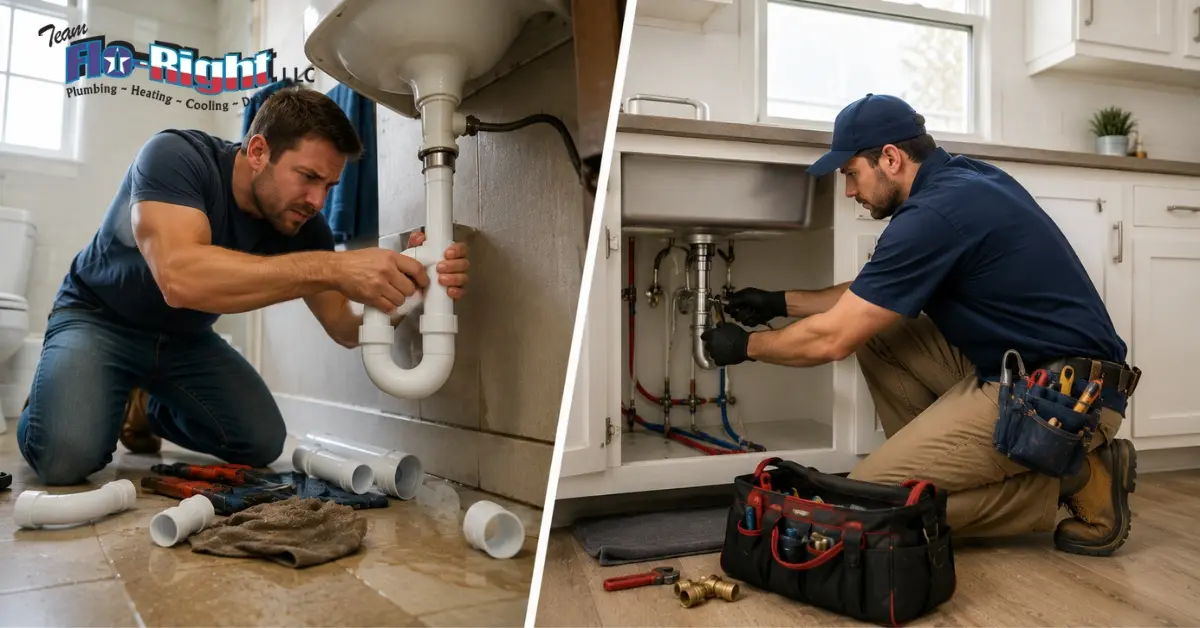
For DIY Plumbing vs Licensed Plumber Austin, simple fixture swaps are fine to do yourself, but anything touching your water line, gas line, or main plumbing system needs a licensed plumber in Austin, TX. Texas law sets that line, and skipping it can also cost you your insurance coverage if something goes wrong later.
Key Differences DIY Plumbing vs Licensed Plumber Austin
DIY and a licensed plumber differ most on cost, tools, code compliance, and who covers the risk if something fails. Here’s how each one stacks up.
| Factor | DIY | Licensed Plumber |
| Upfront cost | Lower (parts only) | Higher (labor + parts) |
| Tools required | Basic home toolkit | Specialized equipment |
| Code compliance | Easy to miss | Built into the work |
| Insurance protection | None | Covered by the plumber’s insurance |
| Permit handling | On you | Handled as part of the job |
| Risk if it fails | You pay to redo it | Covered under warranty |
Upfront cost
DIY: You only pay for parts, so the number on day one looks small.
Licensed Plumber: You pay for labor too, so the starting cost runs higher. That gap only tells half the story once something goes wrong.
Tools required
DIY: A wrench, some plumber’s tape, and whatever’s in a basic home toolkit cover most simple jobs.
Licensed Plumber: A plumber shows up with tools most homeowners will never own, like acoustic leak detectors and pipe cameras, so they find the real problem instead of guessing at it.
Code compliance
DIY: A homeowner doing their own repair can miss a Texas code requirement without ever knowing it.
Licensed Plumber: A licensed plumber builds code into every job automatically, especially on water heaters, gas lines, and main systems.
Insurance protection
DIY: If a pipe you installed yourself fails later, that cost lands on you.
Licensed Plumber: If a pipe a licensed plumber installed fails, their insurance and warranty cover the fallout, not you.
Permit handling
DIY: Pulling a permit is on you, and it’s the step most DIY projects skip.
Licensed Plumber: A licensed plumber pulls the permit as part of the job, which protects you at resale and keeps the work legal.
Risk if it fails
DIY: A failed repair means paying for parts again, plus any damage it caused, plus a plumber to fix it properly.
Licensed Plumber: A warranty covers a failed repair, so the cost stops at the original job.
What You Can Legally DIY in Texas
Texas lets homeowners do plumbing work on their own primary residence without a license. That’s the actual rule, and it opens the door to a handful of real, low-risk projects.
Here’s what falls safely on the DIY side:
- Replacing a faucet aerator or showerhead
- Swapping a worn toilet flapper or fill valve
- Clearing a single clogged drain with a plunger or hand snake
- Tightening a loose, visible connection under a sink
- Installing a new faucet on an existing supply line
These jobs stay visible and accessible. You can see the part, reach the part, and undo the fix if it doesn’t work. None of them touches your home’s water pressure, gallons-per-minute (GPM) supply, or main shutoff valve, which keeps the risk low.
What Requires a Licensed Plumber
Texas draws a hard line the moment a job touches water heaters, gas lines, sewer lines, or your home’s main system. These jobs need a plumber licensed through the Texas State Board of Plumbing Examiners (TSBPE) and working under an active Master Plumber’s licence.
Jobs that always need a licensed plumber:
- Water heater installation or replacement
- Gas line installation, repair, or extension
- Sewer line repair, replacement, or root removal
- Main water line repair
- Full repiping or structural changes to your venting system
- Backflow preventer installation and testing
Water heater installation. A water heater runs hot water, electricity or gas, and pressure through one sealed unit, with a temperature and pressure (T&P) relief valve that has to work correctly. A wrong connection can cause a leak or a gas fire.
Gas line work. The Texas residential code, based on the International Plumbing Code, makes it illegal for a homeowner to install, remove, extend, or modify a gas line. Natural gas is highly combustible, so a small mistake carries a real safety risk.
Sewer line repair or replacement: Root intrusion, pipe replacement, and any tunnelling work on a sewer line fall outside what a homeowner can legally do without a licence.
Main line and structural plumbing work: A major pipe replacement, a full repipe, or any change to your home’s venting system all need a licensed plumber, both for safety and to pass a future inspection.
Texas plumber licences come in three tiers, and knowing the difference helps when you’re checking credentials:
| License Tier | What They Can Do |
| Tradesman Plumber | Basic repairs and installs under supervision |
| Journeyman Plumber | Independent plumbing work, still reports to a Master Plumber |
| Master Plumber | Runs the plumbing business and takes legal responsibility for the work |
Team Flo-Right technicians work under a licensed Master Plumber, so every job on your home meets Texas Administrative Code and passes inspection the first time.
Permits, Insurance, and What DIY Skips
Skipping a permit on a DIY job can void your homeowner’s insurance and cause problems when you sell your home. The City of Austin’s Development Services Department requires a permit for most plumbing work beyond a simple fixture swap, including water heater installs, repiping, and sewer line work. A licensed plumber pulls that permit as part of the job. A DIY project skips it more often than not.
| Job Type | Permit Usually Needed? |
| Faucet or showerhead swap | No |
| Toilet flapper or fill valve repair | No |
| Water heater install or replacement | Yes |
| Gas line work | Yes |
| Sewer line repair or replacement | Yes |
| Full repipe | Yes |
Skipping a permit causes two problems. First, no inspector confirms the work meets code, so you have no proof it was done right. Second, that missing permit can surface later during a home sale, when a buyer’s inspector flags unpermitted work and asks questions you can’t easily answer.
Insurance is the other piece people miss. Some homeowner’s insurance policies in Texas exclude damage caused by unlicensed or unpermitted plumbing work. A DIY pipe failure could leave you paying for water damage and mold cleanup yourself, on top of the original repair cost.
How to Decide: A Quick Checklist
Five yes-or-no questions tell you whether a plumbing job is safe to DIY. Run through them before you start a project yourself.
- Can I see and reach the part without cutting into a wall or floor?
- Does the job avoid gas lines, water heaters, and sewer lines completely?
- Can I turn off the water supply to just this fixture, not the whole house?
- Am I comfortable redoing the job if my first attempt doesn’t work?
- Does this job skip the need for a city permit?
If you answered yes to all five, DIY is probably a safe call. If you answered no to even one, it’s time to call a licensed plumber.
FAQs
Can I install my own water heater in Texas?
No. Texas law requires a licensed plumber for water heater installation. The tank, the gas or electric hookup, and the safety valve all carry real risk if you install them wrong.
Do I need a permit to replace a toilet in Austin?
Usually not for a simple toilet swap on an existing connection. A permit becomes necessary for water heater installs, repiping, and sewer line work.
Can I legally do my own plumbing work in Texas?
Yes, on your own primary residence, as long as you’re the one doing the work. Water heaters, gas lines, and sewer lines still require a licensed plumber.
What happens if a DIY plumbing job fails?
You cover the cost of parts, any water damage, and a plumber to fix it correctly. Your insurance may also deny the claim if you skipped a required permit.
Is it cheaper to hire a plumber than fix it myself?
For small jobs, DIY often costs less upfront. For bigger jobs, a licensed plumber can end up cheaper overall once you factor in the risk of a failed repair.
How do I find a licensed plumber in Austin?
Look up any plumber’s license number on the Texas State Board of Plumbing Examiners website before hiring, and confirm they carry an active Master Plumber license. Team Flo-Right is fully licensed and insured across Austin and Central Texas.
Know When to Call In the Pros
Small fixes are worth doing yourself, but anything touching your water heater, gas line, or main system isn’t worth the risk. Team Flo-Right offers upfront, flat-rate pricing and licensed plumbers for every job that falls outside DIY territory.
